
Two systems control sleep.
Your circadian rhythm sets the timing, and adenosine builds sleep pressure the longer you are awake. Good sleep lines these up.
Why We Sleep
Matthew Walker

Best for: Anyone who treats sleep as optional or struggles to get enough.
2 min read · 6 lessons
Sleep is the single most effective thing you can do for your brain and body.
Matthew Walker, a sleep scientist at UC Berkeley, wrote a sweeping case that sleep is the foundation of health. He explains how the body clock and sleep pressure work, what happens during deep non-REM sleep and REM sleep, and why both stages matter.
Walker connects short sleep to poorer memory, emotional volatility, weakened immunity, metabolic problems, heart disease and higher accident risk. He describes how deep sleep helps consolidate memories and how REM sleep helps process emotions and boost creativity.
The final section gives practical guidance for better sleep and calls for change in schools, hospitals and workplaces. Some specific claims have been debated by other researchers, but the core message, that sleep deserves priority, is widely shared.
Why We Sleep made sleep science a mainstream topic and convinced many readers to prioritize rest. Some critics, including other scientists, pointed out errors and overstatements in specific claims, so it is best read as a strong case for sleep rather than a perfect summary of the research. Its practical advice is widely shared by sleep experts.
Your circadian rhythm sets the timing, and adenosine builds sleep pressure the longer you are awake. Good sleep lines these up.
Going to bed and waking at the same times, even on weekends, is Walker's top recommendation.
Deep sleep helps move new learning into long-term storage. Pulling an all-nighter undercuts studying.
Dream sleep helps soften emotional memories and makes creative connections between ideas.
Caffeine lingers for hours and blocks sleep pressure. Alcohol sedates but fragments sleep and suppresses REM.
Keep it cool, dark and quiet, dim lights in the evening and keep screens out of bed.
Walker calls regularity the single most important tip. Weekends included. A steady wake time anchors your whole circadian rhythm.
Your core temperature needs to drop to start sleep. Walker suggests a room around 65°F (about 18°C).
Caffeine has a half-life of roughly five to six hours, so half of an afternoon coffee is still in you at bedtime. Cut it off early.
A nightcap sedates you, which is not the same as sleep. It fragments the night and suppresses REM sleep, the stage tied to emotional processing.
If you cannot sleep after a while, get up and do something calm in dim light, then come back when sleepy. Your brain should link bed with sleep, not frustration.
Bright and blue light in the hours before bed delays melatonin. Lower the lights and screens as night falls.
Anyone who treats sleep as optional or struggles to get enough.
You want a measured, cautious scientific review.
Critics, including researcher Alexey Guzey, documented errors and exaggerations in some claims and charts. The core advice to prioritize sleep is still widely supported.
| Book | Why We Sleep Matthew Walker 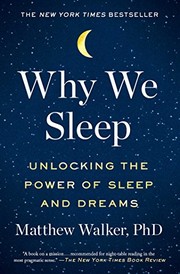 Why We Sleep | Say Good Night to Insomnia Gregg D. Jacobs Say Good Night to Insomnia | The Circadian Code Satchin Panda The Circadian Code |
|---|---|---|---|
| Core thesis | Sleep is the single most effective thing you can do for your brain and body. | Insomnia is usually learned, and it can be unlearned without pills. | Timing eating, light and sleep to your body clock improves health. |
| Best for | Anyone who treats sleep as optional or struggles to get enough. | People with ongoing trouble falling or staying asleep. | Shift workers, night owls and anyone curious about timing their day better. |
| Problems it solves | Sleep Problems, Stress & Anxiety | Sleep Problems, Stress & Anxiety | Sleep Problems, Weight & Eating |
| Lessons | 6 | 3 | 3 |
| Year | 2017 | 1998 | 2018 |