
Traction versus distraction.
Traction is any action that moves you toward what you planned. Distraction pulls you away. Checking email can be either, depending on whether you intended to.
Indistractable
Nir Eyal
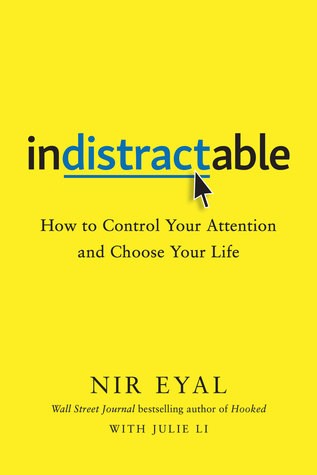
Best for: Anyone who keeps picking up their phone without meaning to.
2 min read · 4 lessons
Distraction is mostly an escape from discomfort, and you can manage it.
Nir Eyal wrote Hooked, a guide to building habit-forming products. Indistractable is his answer to the other side of the problem: how individuals can take back control of their attention.
His key insight is that distraction usually starts inside us. We reach for a device to escape uncomfortable feelings like boredom, loneliness or anxiety. External triggers like notifications matter, but the internal triggers come first.
Eyal's model has four parts: master internal triggers, make time for traction, hack back external triggers and prevent distraction with pacts. He also covers distraction at work and how to raise kids who manage their own attention.
Indistractable is notable because its author previously taught companies how to make habit-forming products. That inside view makes his advice credible. The book is practical and balanced, showing how to manage distraction without demonizing technology.
Traction is any action that moves you toward what you planned. Distraction pulls you away. Checking email can be either, depending on whether you intended to.
Notice the feeling right before you get distracted, write it down and explore it with curiosity instead of acting on it.
Use a timeboxed calendar that includes time for yourself, your relationships and your work. You cannot be distracted if you have no plan.
Ask whether each ping serves you. Turn off notifications, clean up your phone's home screen and set signals at work for focus time.
Effort pacts add friction, price pacts add a cost, and identity pacts let you call yourself indistractable so your behavior follows.
At work, constant distraction is often a sign of a culture problem. Teams need psychological safety to discuss and fix it.
Eyal argues we reach for the phone to escape discomfort like boredom or anxiety. Notice the feeling first and you can choose not to flee it.
When an urge hits, tell yourself you can give in, just not for ten more minutes. Urges usually crest and fade like a wave.
You cannot call something a distraction unless you know what it distracted you from. Plan your week on a calendar around what matters, including rest and people.
Use effort pacts, price pacts and identity pacts. Remove the option to be distracted before temptation shows up.
Anyone who keeps picking up their phone without meaning to.
You want a critique of tech companies rather than personal tactics.
Critics point out that Eyal previously taught companies to build habit-forming products, and the book places much of the responsibility on individuals.
| Book | Indistractable Nir Eyal  Indistractable | Deep Work Cal Newport  Deep Work | Digital Minimalism Cal Newport  Digital Minimalism |
|---|---|---|---|
| Core thesis | Distraction is mostly an escape from discomfort, and you can manage it. | Focused, distraction-free work is rare, valuable and trainable. | Use technology on purpose instead of by default. |
| Best for | Anyone who keeps picking up their phone without meaning to. | Knowledge workers, students and creators who want to produce work that matters. | Anyone who feels their phone is running their life. |
| Problems it solves | Focus, Procrastination, Bad Habits | Focus, Procrastination, Career Growth | Focus, Stress & Anxiety, Bad Habits |
| Lessons | 4 | 4 | 3 |
| Year | 2019 | 2016 | 2019 |