
Two systems shape thinking.
System 1 jumps to conclusions. System 2 can check them but is lazy and easily tired.
Thinking, Fast and Slow
Daniel Kahneman

Best for: Anyone who makes decisions, which is everyone, especially leaders and investors.
1 min read · 4 lessons
Human judgment has predictable flaws you can learn to catch.
Daniel Kahneman, a psychologist who won the Nobel Prize in Economics, summarizes decades of research, much of it with Amos Tversky, on how people actually make judgments and decisions.
He describes two modes of thinking. System 1 is fast, automatic and intuitive. System 2 is slow, deliberate and effortful. System 1 is usually helpful but relies on shortcuts that cause predictable errors.
The book covers biases like anchoring, availability and overconfidence, prospect theory, loss aversion and the difference between the experiencing self and the remembering self.
Thinking, Fast and Slow is one of the most influential books on human judgment. Some studies it cites have not replicated, especially in priming research, but its core framework and many of its biases remain widely accepted.
System 1 jumps to conclusions. System 2 can check them but is lazy and easily tired.
We build confident stories from limited information without noticing what is missing.
An initial number influences estimates even when it is irrelevant.
Losing something hurts about twice as much as gaining the same thing feels good.
Look at base rates from similar situations before trusting a specific plan.
We judge experiences mostly by their peak and their end, not their total duration.
System 1 is fast, automatic and intuitive. System 2 is slow and effortful. Most mistakes happen when System 1 answers a question that needed System 2.
Before judging a specific case, ask how often things like this usually turn out. Kahneman calls this taking the outside view.
Kahneman champions Gary Klein's technique: imagine it is a year from now and the plan failed, then write the story of why. It surfaces risks no one wanted to mention.
The first number you hear pulls your estimate toward it, even when it is random. Set your own number before seeing anyone else's.
Anyone who makes decisions, which is everyone, especially leaders and investors.
You want a quick, light read.
Some studies it cites, especially on priming, have failed to replicate, and Kahneman later acknowledged this. The book is long and dense in places.
| Book | Thinking, Fast and Slow Daniel Kahneman 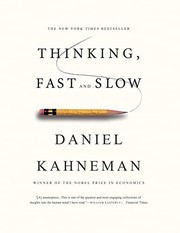 Thinking, Fast and Slow | Thinking in Bets Annie Duke Thinking in Bets | The Scout Mindset Julia Galef The Scout Mindset |
|---|---|---|---|
| Core thesis | Human judgment has predictable flaws you can learn to catch. | Life is like poker: decisions involve uncertainty and luck. | Seeing clearly matters more than feeling right. |
| Best for | Anyone who makes decisions, which is everyone, especially leaders and investors. | Decision makers who want to separate luck from skill. | Anyone who wants to see clearly, especially when the truth is uncomfortable. |
| Problems it solves | Decision Making, Overthinking | Decision Making, Overthinking | Decision Making, Overthinking |
| Lessons | 4 | 3 | 3 |
| Year | 2011 | 2018 | 2021 |