
Think probabilistically.
Express predictions as probabilities.
The Signal and the Noise
Nate Silver
Best for: Anyone interested in data, forecasting and uncertainty.
1 min read · 3 lessons
Good forecasting means thinking probabilistically, updating with evidence and separating signal from noise.
Nate Silver examines predictions in weather, economics, sports, politics and more, showing why some fields forecast well and others do not.
He advocates Bayesian thinking: start with prior beliefs and update with evidence.
Silver gives a practical, readable guide to probabilistic thinking.
Express predictions as probabilities.
Bayesian reasoning means starting with a reasonable estimate and adjusting it as evidence arrives.
Models that explain every past wiggle often fail on new data because they fit noise.
Weather forecasts improved because forecasters get fast, honest feedback on their accuracy.
Good forecasters admit uncertainty and avoid sounding more precise than the data allows.
Put a number on how likely you think something is, instead of a vague feeling.
Adjust your estimates as new evidence arrives, the way weather forecasters do.
Trust forecasters and models based on how accurate they have been.
Anyone interested in data, forecasting and uncertainty.
You want quick tips.
Some chapters are long, and some readers find the Bayesian focus repetitive.
| Book | The Signal and the Noise Nate Silver The Signal and the Noise | Thinking, Fast and Slow Daniel Kahneman 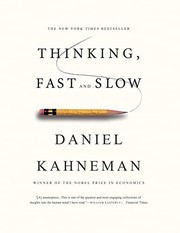 Thinking, Fast and Slow | Superforecasting Philip E. Tetlock and Dan Gardner Superforecasting |
|---|---|---|---|
| Core thesis | Good forecasting means thinking probabilistically, updating with evidence and separating signal from noise. | Human judgment has predictable flaws you can learn to catch. | Good forecasting is a learnable skill, not a gift. |
| Best for | Anyone interested in data, forecasting and uncertainty. | Anyone who makes decisions, which is everyone, especially leaders and investors. | Analysts, investors, leaders and anyone who wants to predict better. |
| Problems it solves | Decision Making | Decision Making, Overthinking | Decision Making |
| Lessons | 3 | 4 | 3 |
| Year | 2012 | 2011 | 2015 |