
Control your perceptions first.
Before acting, strip away the emotional story. Describe the situation objectively, as if it happened to someone else.
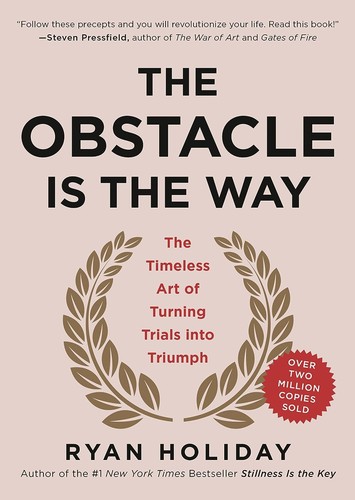
The Obstacle Is the Way
Ryan Holiday
Best for: People facing a setback who want a practical, Stoic way through it.
2 min read · 3 lessons
Every obstacle holds the material for moving forward.
Ryan Holiday takes an idea from Marcus Aurelius, that what stands in the way becomes the way, and builds a short, punchy guide to handling adversity. Each chapter pairs a Stoic principle with stories from people like John D. Rockefeller, Amelia Earhart, Thomas Edison and Ulysses S. Grant.
The book is organized into three disciplines. Perception means seeing a situation clearly, without panic or exaggeration. Action means attacking the problem with energy, persistence and creativity. Will means accepting what you cannot change and preparing for what might go wrong.
Holiday's point is that obstacles are not only things to get past. They are training. Every problem forces you to build a skill or find a route you would not have found otherwise.
This book helped spark a modern revival of Stoicism. It became a favorite of professional athletes, coaches and executives because it turns ancient philosophy into something you can use before a big game or a hard meeting. It is short, story-driven and easy to return to whenever you are stuck.
Before acting, strip away the emotional story. Describe the situation objectively, as if it happened to someone else.
Your effort, attitude and choices are yours. Outcomes, other people and luck are not. Put energy only where it counts.
Break overwhelming problems into the next small step and do it well. Holiday borrows Nick Saban's focus on doing this play right instead of thinking about the scoreboard.
Edison tested thousands of materials for the lightbulb. Persistence plus small adjustments beats waiting for one perfect move.
The Stoics practiced imagining what could go wrong, not to worry but to be ready. Expecting setbacks makes them easier to absorb.
Holiday ends with amor fati, loving your fate. Accepting reality fully frees up energy to make the most of it.
First see the problem clearly without panic. Then act on it with energy and persistence. Then accept with grace whatever stays outside your control.
Holiday borrows Nick Saban's idea of the process: do not think about the championship, think about this play. Big problems shrink when broken into the next correct step.
Every obstacle forces some new skill, angle or advantage. Ask what this situation makes possible that was not possible before.
People facing a setback who want a practical, Stoic way through it.
You want a rigorous history of Stoic philosophy.
Some scholars see it as a simplified version of Stoicism, and the historical stories are chosen to fit the message rather than examined in depth.
| Book | The Obstacle Is the Way Ryan Holiday  The Obstacle Is the Way | Learned Optimism Martin E. P. Seligman  Learned Optimism | The Power of Now Eckhart Tolle The Power of Now |
|---|---|---|---|
| Core thesis | Every obstacle holds the material for moving forward. | Optimism is a thinking skill you can learn, not a personality trait. | Most suffering comes from identifying with the thinking mind, and peace is found by living fully in the present moment. |
| Best for | People facing a setback who want a practical, Stoic way through it. | Anyone prone to pessimism, worry or giving up after setbacks. | Overthinkers and anyone drawn to spiritual approaches to calm. |
| Problems it solves | Stress & Anxiety, Overthinking, Low Motivation | Overthinking, Self-Criticism, Stress & Anxiety | Overthinking, Stress & Anxiety |
| Lessons | 3 | 3 | 3 |
| Year | 2014 | 1990 | 1997 |