
Focus on systems, not goals.
Goals set direction, but systems produce progress. Fall in love with the daily process and the results tend to follow.
Atomic Habits
James Clear

Best for: Anyone who wants practical, step-by-step tools to build good habits and drop bad ones.
2 min read · 6 lessons
Tiny changes, repeated, compound into remarkable results.
James Clear's central idea is that tiny habits compound like interest. Getting 1 percent better each day adds up to enormous change over a year, and 1 percent worse compounds just as powerfully in the wrong direction. Results lag behind effort, so most people quit before the payoff arrives.
Clear argues that systems matter more than goals. Winners and losers often share the same goals. The difference is the daily process. And lasting change starts with identity: every action is a vote for the type of person you want to become.
The bulk of the book lays out four laws of behavior change, each with specific techniques, and the reverse of each law for breaking bad habits.
Atomic Habits has sold more than 20 million copies and is one of the most recommended self-improvement books ever. Its strength is practicality: every chapter ends with something you can do today. Clear pulls together research and examples from sports, business and everyday life into a system that is easy to remember and easy to start.
Goals set direction, but systems produce progress. Fall in love with the daily process and the results tend to follow.
Decide who you want to be, then prove it with small wins. Saying 'I'm not a smoker' is stronger than saying 'I'm trying to quit.'
Use implementation intentions: I will do this behavior at this time in this place. Pair new habits with existing ones through habit stacking.
Bundle habits you need with things you enjoy. Reduce friction so the right action takes less effort, and use the two-minute rule to start small.
Behaviors that feel good right away get repeated. Use habit trackers and small rewards, and never miss twice in a row.
People with great self-control usually just avoid tempting situations. Rearrange your space so good habits are visible and bad ones are out of reach.
To build a habit make it obvious, attractive, easy and satisfying. To break one, flip them: make it invisible, unattractive, difficult and unsatisfying.
Outcome goals are fragile. Identity sticks. Each rep is a vote for the person you are becoming, so think 'I am a runner' rather than 'I want to run a marathon'.
Scale any new habit down to two minutes. Read one page. Put on your running shoes. Master showing up before you worry about doing more.
Use the formula: after I do my current habit, I will do my new habit. After I pour my coffee, I will write down three priorities.
Missing once is an accident. Missing twice is the start of a new habit. When you slip, get back on the very next chance.
Environment beats willpower. Put the guitar in the middle of the room and the phone in another one. Make cues for good habits visible and bad ones hidden.
Anyone who wants practical, step-by-step tools to build good habits and drop bad ones.
You have already read several habit books and want new science.
Most ideas are a synthesis of earlier research and books rather than new findings, and many examples are anecdotes. Some readers find the four laws more memorable than evidence-based in their details.
| Book | Atomic Habits James Clear 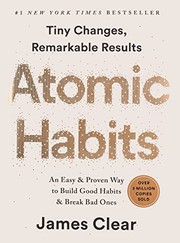 Atomic Habits | Tiny Habits BJ Fogg Tiny Habits | The Power of Habit Charles Duhigg  The Power of Habit |
|---|---|---|---|
| Core thesis | Tiny changes, repeated, compound into remarkable results. | Behavior happens when motivation, ability and a prompt come together, so make habits tiny and celebrate them. | Habits run on a cue, routine and reward loop you can rewire. |
| Best for | Anyone who wants practical, step-by-step tools to build good habits and drop bad ones. | People who struggle to stick to habits. | Readers who want to understand the science of habits in people, companies and societies. |
| Problems it solves | Bad Habits, Procrastination, Low Motivation | Bad Habits, Low Motivation | Bad Habits, Career Growth |
| Lessons | 6 | 3 | 4 |
| Year | 2018 | 2019 | 2012 |